.svg)
Book Now
Quick Summary
Before diving into the full story, here’s a clear snapshot of the key ideas we explored with The Art Engager.
- Museums are vaults of stories as much as vaults of objects, and our job is to hand the visitor the key.
- The "Age 12 Cliff" is real, marking the moment society tells us to stop playing to learn, which is a tragedy we are working to reverse.
- Roleplay is the ultimate behavioral nudge, because when you give a visitor a badge and a job title, they treat the space with more respect than a regular tourist.
- Tangible history sticks, meaning a child will remember the metric system if they have to measure a table with their own thumb.
- Kill your darlings, because you cannot tell every fact on the wall text if you want the audience to feel the emotional truth of the narrative.
There is a specific kind of hush that falls over you when you walk into a museum. It is respectful and heavy. You lower your voice. You clasp your hands behind your back. You look, you read, and you move on.
But we have always wondered what would happen if you were allowed to lean in.
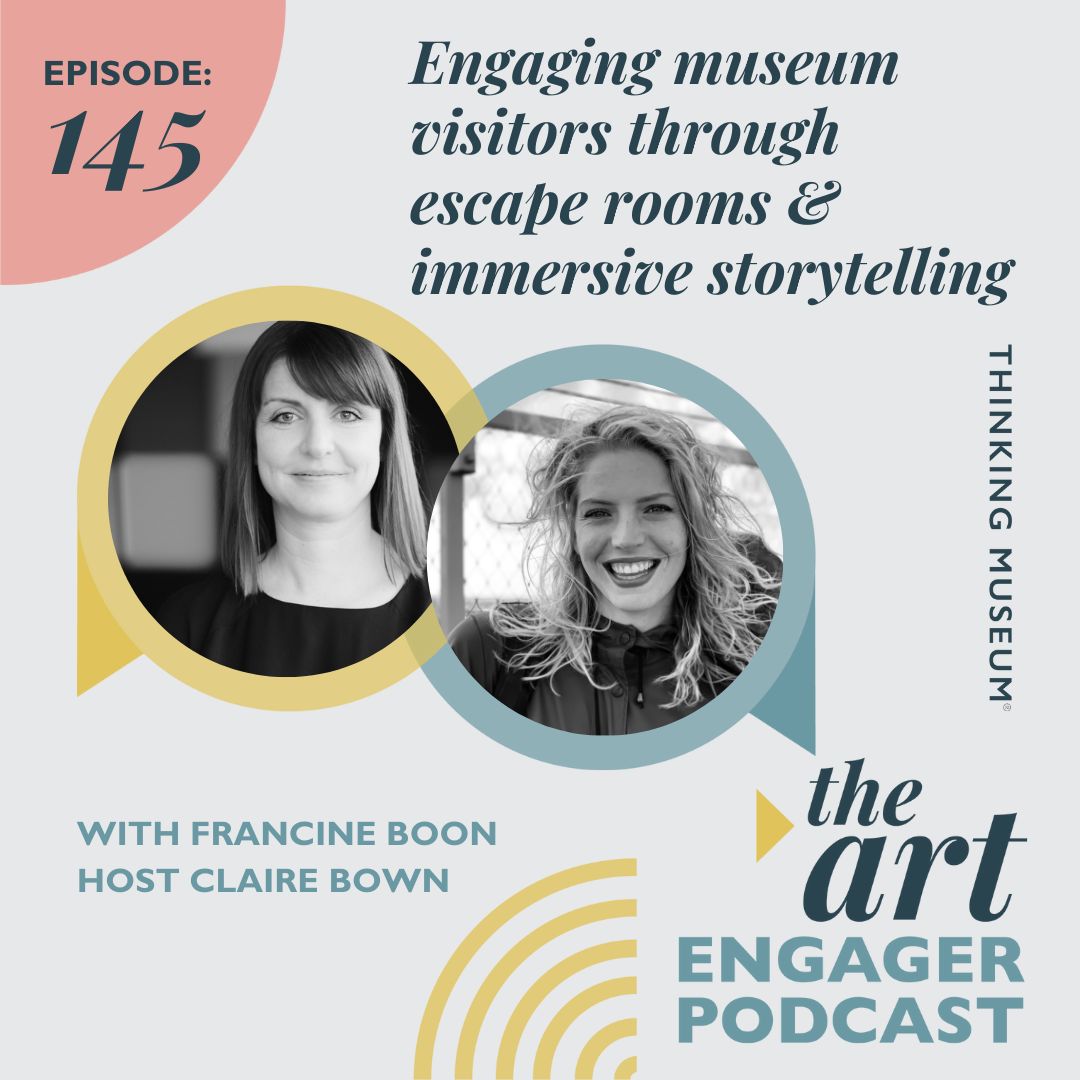
Our co-director Francine Boon sat down with Claire Bown on The Art Engager podcast to discuss exactly that. Francine is a sociologist turned mystery maker, and she has spent years obsessed with the alchemy of turning passive observation into active participation. She shared the messy, wonderful process behind our collaborations with the Rijksmuseum and the Amsterdam Royal Palace, where we tried to answer a simple question.
How do we get adults to play again?
The Cliff where We Stop Playing
There is a strange moment in growing up where the rules suddenly change. Up until we are about twelve years old, everyone agrees that play is the best way to learn. We learn empathy by playing house and we learn physics by building towers.
Then the clock strikes twelve and we are told to sit down. We are told to listen. We are told that learning is serious business and that play is for the playground.
Francine spoke about this "cliff" with a lot of passion because it drives so much of what we do at Sherlocked. We believe that play is a potent state of mind for processing information. When you enter a make-believe environment, you are safe to fail. You are safe to try on a new identity. We have seen adults come out of our experiences surprised by their own leadership or their own cleverness.
When we brought this philosophy to the Rijksmuseum, we wanted to bridge that gap. We wanted to give people permission to be curious again.
Designing for the Unwritten Rules
One of the most fascinating challenges of working in a heritage site is the tension between immersion and preservation. The curators, quite rightly, are terrified. They picture a game and they imagine people running through the gallery and knocking over a 17th-century vase.
We had to find a way to make the game exciting while making the players the safest people in the room.
Our solution was a lesson in behavioral psychology. We didn't ask people to come as gamers. We asked them to come as "Interns." We created a narrative where they were new hires for a fictional curator named Bert. We gave them official-looking badges and sent them on a mission.
The result was serendipity. Because they felt like staff, they behaved like staff. They didn't run. They shushed other noisy visitors. By blurring the line between fiction and reality, we gave them a role that came with responsibility. It turns out that if you treat your audience like heroes, they will rise to the occasion.
When History Becomes Tactile

For the Royal Palace in Amsterdam, the challenge was different. We were tasked by the King to engage a group that is notoriously difficult to impress: school children aged ten to twelve.
The Palace is a stunning building, but it can feel cold and distant to a ten-year-old. We wanted to make the history feel gritty and real. We focused on the era of Louis Napoleon, who introduced the metric system to The Netherlands.
We could have written a placard about it. Instead, we built a puzzle.
We gave the kids "thumbs" of a standardized size and asked them to measure the furniture, just as people did before the meter existed. They realised quickly that measuring with a thumb is inaccurate and frustrating. When they finally unlocked the "metric system" in the game, it wasn't just a fact. It was a solution to a problem they had physically felt.
This is the difference between showing an object and sharing a story.
The Vaults of Stories
We often think of museums as places that house objects, but Francine describes them as vaults of stories. The objects are just the debris left behind by human lives.
In the Rijksmuseum, we built a quest around a painter named Torrentius. He was a libertine, a member of a secret society, and a rival to Rembrandt. Today, only one of his paintings survives. It hangs in the museum, often overlooked because it sits high up on the wall above a more famous piece.
By turning that painting into the focal point of a mystery, we forced people to really look at it. We didn't just tell them it was important. We made it the key to their success.
Dive Deeper into the Method
We covered so much ground in this conversation that we wanted to break it down further for you. Whether you are an educator, a curator, or just someone who loves a good puzzle, we have unpacked these lessons in our new series of deep dives.
- For the educators: We explore the specific mechanics of engaging the 12-18 demographic, a group that often feels unreachable.
- For the curators: We tackle the "Do Not Touch" dilemma and how to design interactivity that protects your collection.
- For the storytellers: We look at how to find the "ghost" in your building and turn historical facts into narrative gold.
We are so up for continuing this conversation. If you have a building full of stories that are waiting to be told, feel free to reach out. Let’s make some magic.
Table of Contents