.svg)
Book Now

Quick Summary
Before diving into the full story, here’s a clear snapshot of the key ideas...
- The palace becomes a living classroom, where puzzles turn history into something tactile and playful.
- Three eras of Amsterdam collide, guiding players through city hall, empire, and kingdom in one flowing narrative.
- Design constraints shape the magic, forcing us to build a quest that leaves no trace yet changes how you see the building.
- Children co-author the ending, adding their own hopes and worries into the archive of the palace.
- Play reveals character, showing how curiosity and collaboration flourish when kids feel trusted with history.
Inside the halls of the Royal Palace in Amsterdam, history does not sit quietly. It hums under the marble floor, in the paintings, in the soot baked into the stone. For a studio often associated with immersive escape rooms in Amsterdam, the challenge here was a different kind of puzzle. It was never about finding stories. It was about letting a room full of children step inside them.
Palace Mysteries began as an invitation to turn centuries of Amsterdam into something tactile, playful, and alive for school classes aged 10 to 12. What followed was a design process full of constraints, experiments, and small moments of serendipity. This is a look behind the curtain at how an educational quest takes shape inside a working palace.
When a Building Whispers Its Past
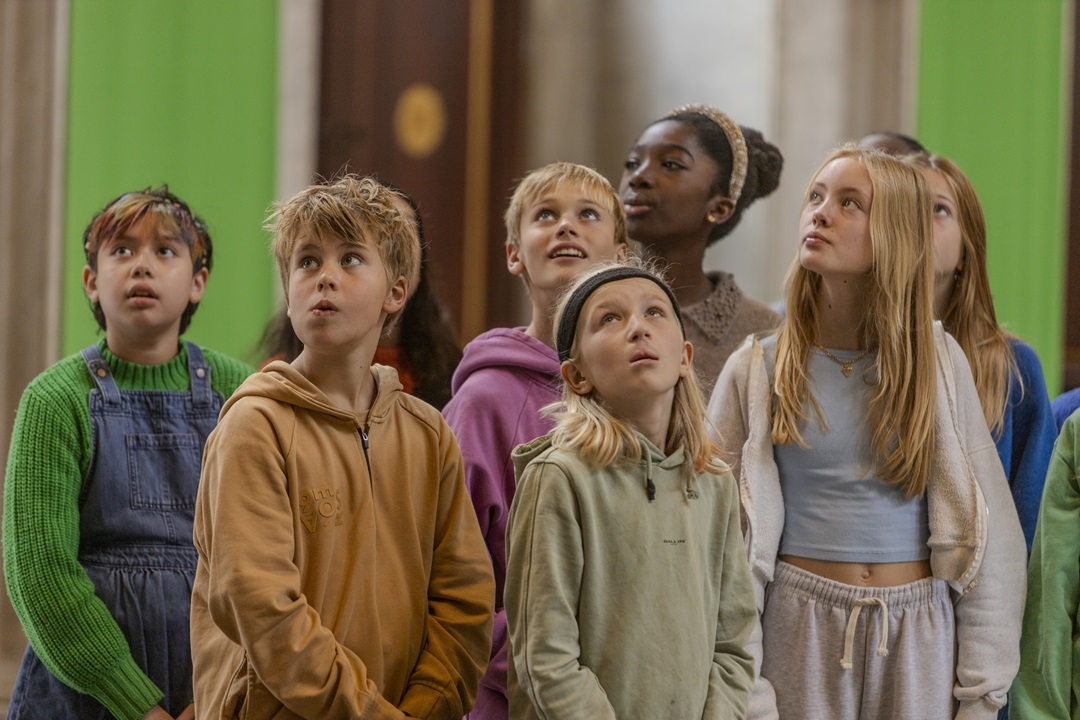
The first time you stand in the main hall of the Royal Palace, you feel very small. The marble floor stretches out like a frozen sea, maps of the world under your feet, constellations overhead. It is a place designed to impress, but also to hush you. Your voice lowers without asking permission.
And yet the paradox is this. The palace is not quiet at all. It is loud with stories. You just need a reason to lean in.
Palace Mysteries was born from that tension. The palace asked us to create a quest for children between 10 and 12, a way to celebrate 750 years of Amsterdam without turning the building into a lecture. The brief was simple on paper and messy in reality.
How do you translate centuries of politics, justice, marriages, and empire into something a class of restless kids can feel in their hands? Our answer was not to simplify the history. It was to let the building speak for itself.
Three Chests and a Guide in Mild Panic
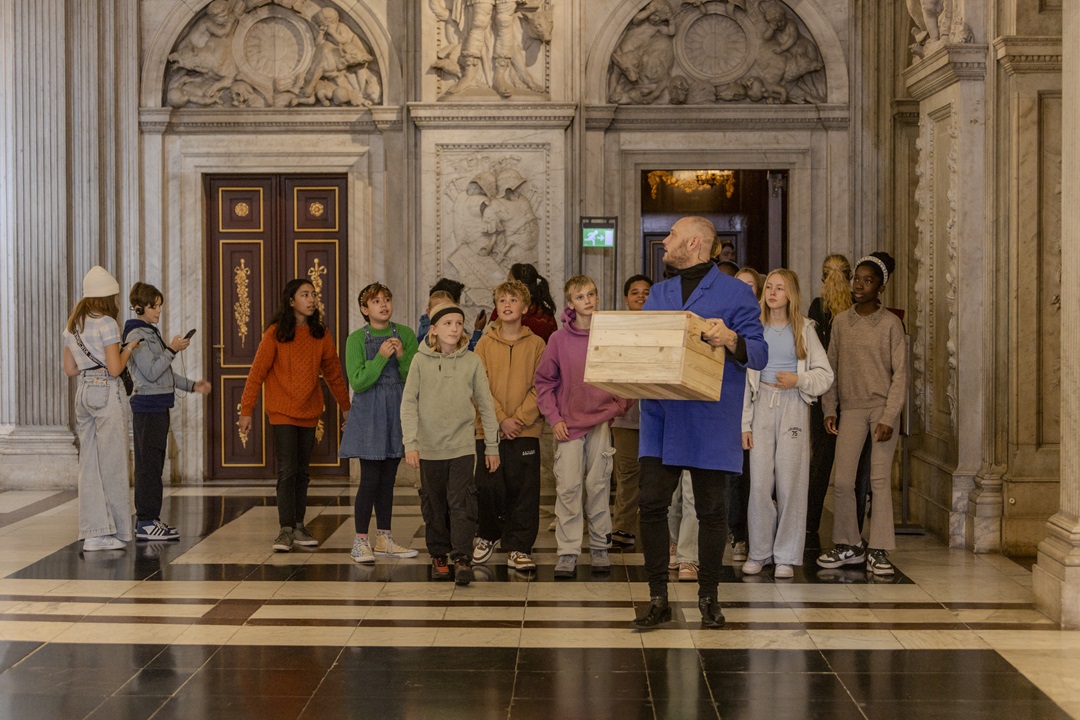
Every good story starts with a small emergency. Ours begins with an eccentric palace guide who has found three locked chests in a forgotten attic. The king is visiting tomorrow. Nobody knows what is inside. Would you help open them?
That invitation shifts the room instantly. The palace is no longer a monument. It is a puzzle box.
The children use the enormous floor maps to orient themselves, discovering that the world beneath their shoes is incomplete. North America is barely sketched in, because when the maps were made, much of it was still unknown. That moment of recognition lands with a spark of intuition. History is not a finished picture. It is a draft.
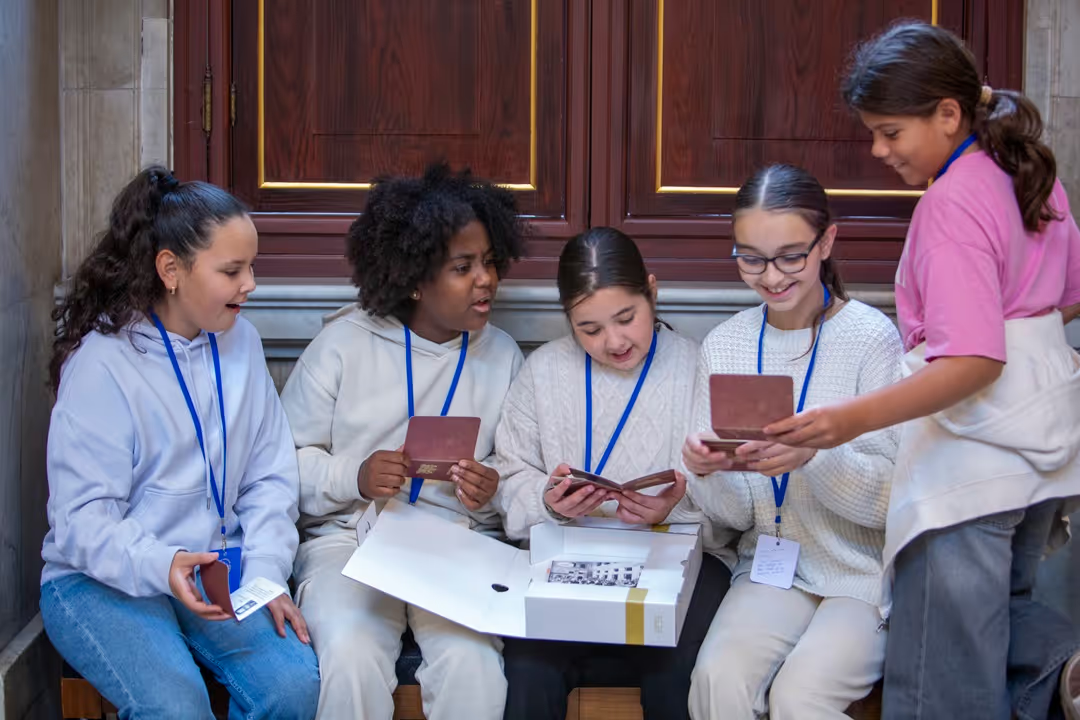
Each chest leads into a different era. One folder belongs to the time when the building was city hall, a place of marriages, bankruptcies, and public justice. Another carries the mark of Louis Napoleon, who forced the cold civic building into becoming a palace and brought the metric system along with him. The third reflects the modern kingdom, with ceremonies, diplomacy, and the choreography of state banquets.
Instead of reading plaques, the kids measure miniature furniture with their thumbs, then convert those messy human units into centimeters. They reconstruct family lines from paintings. They negotiate seating plans like tiny diplomats. Every puzzle asks them to touch history rather than observe it. The past becomes tactile, a thing you can sort, argue over, and solve together.
Constraints' Lesson on Creativity
There is a funny thing that happens when you design inside a working palace. The building sets the rules, and the rules are strict.
Nothing can be permanently installed. Nothing can scar a wall or linger when the king needs the hall. The entire experience must disappear within an hour, as if it had never been there. At first this feels like a nightmare for designers who love to build elaborate worlds.
Then the constraint turns into alchemy.
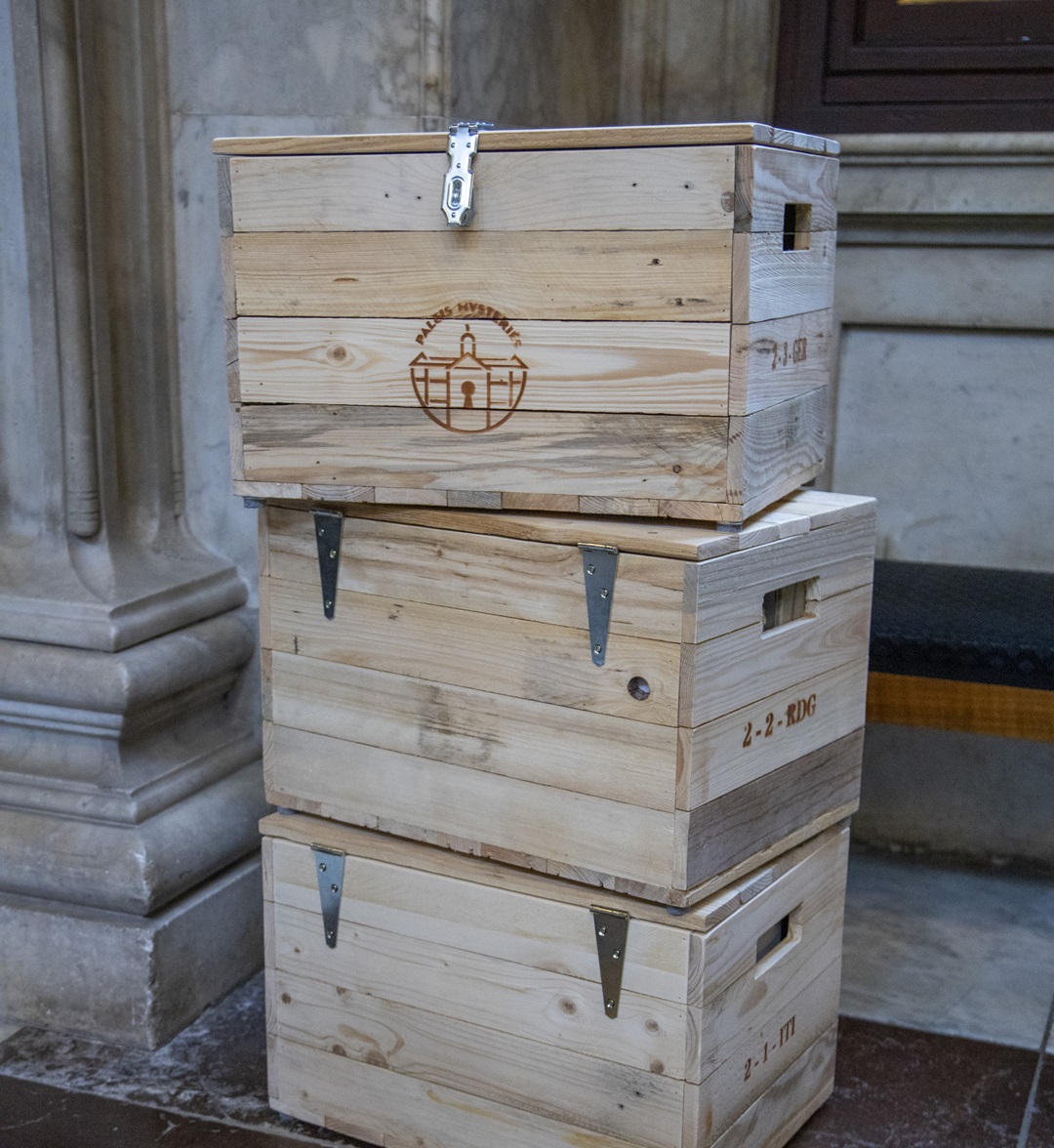
Because we could not change the palace, we had to carry the story in and out with us. The chests became our portable stage. Every prop had to justify its weight. Every mechanic had to be clear enough to run in a busy hall yet rich enough to honor the grit of real history.
The limitation stripped away excess and left a sharper core. We failed a few early prototypes that were too clever for their own good. The palace, politely but firmly, taught us humility.
In the end, the experience feels lighter because of those boundaries. It sits inside the building like a guest who knows how to behave, amplifying what is already there.
The Moment the Future Answers Back

After solving the final chain of puzzles, the children assemble their words into a sentence. The palace speaks to them. This is my history, baked into my stones. What would you like to tell the future?
The room softens. The competitive energy melts into reflection. Some kids write about climate worries. Others archive pancake recipes, favourite bikes, private jokes. One class carefully files their notes into a dedicated folder that will live in the palace archives. Their handwriting joins the long thread of the building.
This was the part we did not fully predict. We expected learning. We did not expect tenderness.
Watching classes test the experience revealed something adults often forget. Children at this in between age are fearless collaborators. When one player gets lost in a logic puzzle, another calmly walks him back through the steps until clarity returns. They lie on the floor to study the ceiling. They narrate their discoveries to the guide with pride. The palace becomes a playground for empathy as much as intellect.
A Palace that Keeps Collecting Voices

Palace Mysteries is, at heart, a conversation between centuries. A seventeenth century city hall speaks to a class from today. The children answer, and their words are tucked into the same building that once announced marriages and verdicts from its balcony.
We came in hoping to make history engaging. We left being reminded that history is not a finished shelf of facts. It is a living archive that grows every time someone adds their small, sincere note.
If you visit the palace now, you will still feel that respectful hush. But if you listen closely, you might also sense the chorus underneath. Marble, soot, laughter, and a stack of folders filled with messages for a future none of us will see. That is the quiet magic we chase. Telling stories about a building, and helping the building collect new ones.
Table of Contents