.svg)
Book Now

Quick Summary
Before diving into the full story, here’s a clear snapshot of the key ideas behind how constraints shaped some of Sherlocked’s most memorable puzzle designs.
- Constraints fuel creativity, helping us make clearer, more intuitive puzzles than we might with limitless time or resources.
- In The Alchemist, the planetary alignment puzzle emerged because the altarpiece was built before the mechanic existed. The fixed structure led to a simpler, more collaborative solution that players still love.
- The Zodiac pentagons were created in ten minutes to fill a pacing gap. Their simplicity turned out to be the perfect fit, proving that quick, uncluttered ideas can carry surprising power.
- In The Vault, a €10,000 puzzle was ultimately removed because it caused confusion. This taught us that expensive or high-tech designs do not guarantee a good player experience.
- Strong design often comes from early, messy prototyping rather than polished concepts. Testing early prevents attachment to ideas that don’t actually work.
- Collaborating with museums like the Rijksmuseum and the Royal Palace showed us how strict rules can inspire mechanics. When you can’t move or touch anything, the building itself becomes the gameplay.
- Simple puzzles tend to outperform complex ones because they are readable, cooperative, and satisfying, allowing players to feel clever rather than overwhelmed.
- Many common design pitfalls, such as overcomplication or overbuilding, are naturally avoided when you design within clear boundaries.
- At the heart of every strong puzzle is a focus on clarity, story fit, and how players feel while solving, rather than complexity or spectacle.
If you’ve ever played one of our games, you’ve stepped into a world shaped by the limits we work within: the tight spaces, fixed budgets, and real environments that guide every puzzle we create.
Over the years, we’ve discovered, often by joyful accident, occasionally by expensive misstep, that constraints aren’t creative obstacles. They’re creative tools. They sharpen ideas. They keep us honest. They push us into unexpected solutions that feel more human, more tactile, and more satisfying for players.
And if you’re exploring how to design a strong escape room yourself, or wondering why your most complicated prototypes keep misbehaving, we’d love to share what we’ve learned from our own very real, very imperfect process.
The Creative Paradox: Why Less is Often Better

There’s a funny thing that happens when you give any designer total freedom: they freeze.
Blank pages look exciting until you actually have to start. Spacious budgets seem helpful until every option is suddenly on the table. Infinite choice creates fog, not clarity.
Inside Sherlocked, we’ve noticed that our best work rarely comes from wide-open possibilities. It comes from the moment where something narrows: budget, space, time, materials, and we’re forced to make decisions based on what’s truly essential.
Francine, our co-director and leader of the Game Design team, once described it beautifully:
“When we have no budget and almost no time left, that’s often when I see all the puzzle pieces clearly. Suddenly the problem has a shape.”
And once a problem has a shape, the path forward becomes much easier to find.
That’s why constraints aren’t something we fight in escape room design. They’re something we lean into. They guide the room toward a clearer story and cleaner puzzle flow, often more naturally than any brainstorming session could.
The MacGyver Mindset

When options shrink, focus sharpens. We affectionately call this the MacGyver mindset: the creative mode where you stop dreaming about what could be, and start building with what actually exists in your hands.
Francine seems to slip into this mode instinctively. When time is tight and the materials are few, she doesn’t panic, she starts sketching mental blueprints at lightning speed. It is not improvisation in a frantic way. It is an instinctive shift where limits create clarity.
This approach usually leads us toward puzzles that are grounded and easy for players to understand. Limited resources tend to push us into mechanics based on communication, observation, teamwork, and simple tactile interactions. Things players can grasp quickly without needing a long explanation.
And that’s usually what players resonate with most.
The Alchemist and its Planetary Alignment Puzzle
.jpg)
During the creation of The Alchemist, we found ourselves in a situation where the carpenters needed to build a large wooden altarpiece before we had fully designed the puzzle it would contain. The structure, format, and story beat were set long before the mechanic was ready.
It was stressful, yes. But it also created a very clear frame.
Instead of reaching for something complex to fill the space, Francine leaned into what the environment already suggested. She imagined a ritual where planets needed to be aligned, and the players would take part in a simple but layered task. No advanced technology. No hidden electronics. Just a clear, collaborative moment that belonged to the world.
Players often tell us it’s one of their favourite moments.
Not because it’s grand. Not because it’s difficult. But because it fits with the story, the set, and the rhythm of the room.
When physical limits are tight, you’re less tempted to overcomplicate. You stick closer to the story. You choose mechanics players can grasp immediately. You build something that invites them in rather than showing off at them.
The 10-minute Puzzle of The Zodiac Pentagons
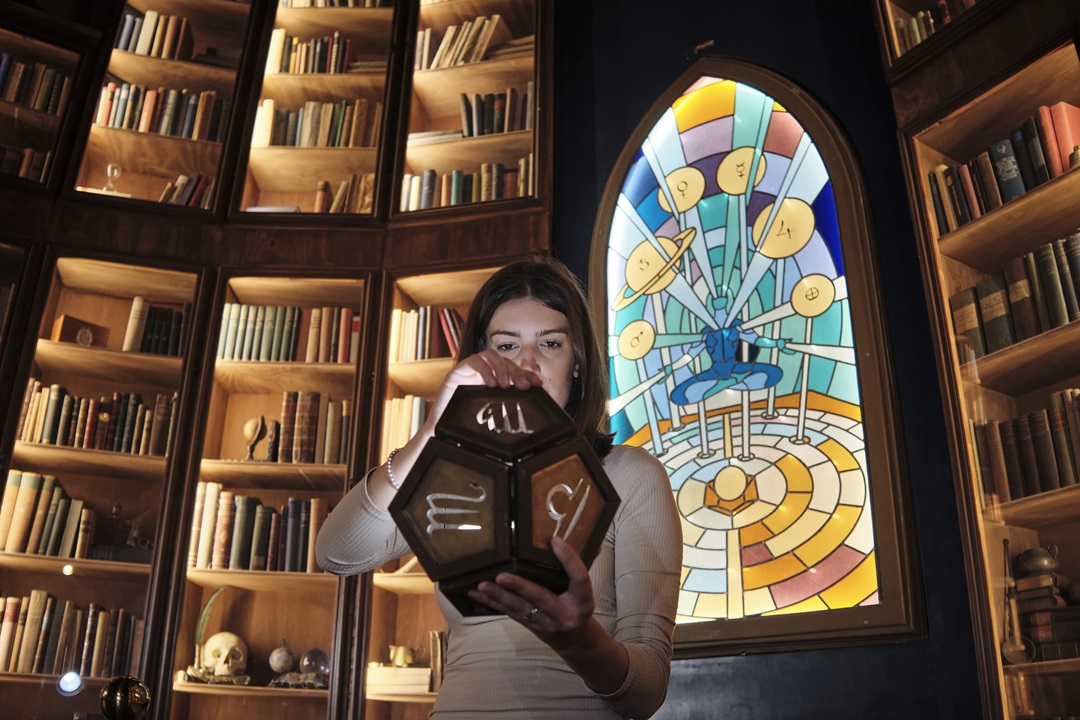
Another moment that taught us about simplicity came from a very different direction: urgency. During the later stages of The Alchemist, we realised a small pacing gap needed to be filled. We had a meeting starting in ten minutes. The puzzle needed to exist before that meeting.
Francine folded a few shapes. Victor looked at them and recognised immediately that it was enough. And somehow, that quick idea became exactly what the experience needed. A small folding puzzle with Zodiac pentagons that players still find surprisingly satisfying.
Victor still remembers it:
“We just needed something quick, and somehow it turned out to be exactly what the game needed. The right kind of easy.”
Players love it precisely because it wasn’t overdesigned.
Sometimes the puzzle you design in ten minutes is better than the one you’d design in ten days. Time pressure prevents the overthinking that often leads to muddy, confusing interactions.
The €10,000 Lesson: Expensive Doesn’t Mean Effective

Not every moment in our design history has been elegant. While developing The Vault, we built an elaborate puzzle that cost roughly €10,000. It involved custom engineering and a lot of pride.
It is still inside the building. But it is not in the game.
Once players began testing the room, the puzzle created confusion, broke the flow, and weighed down the momentum. It was impressive as an object but unclear as an interaction. We had tested it too late, after becoming attached to the idea.
Victor summed it up honestly:
“We spent 10,000 euros on puzzles that just caused too much confusion.”
This was a turning point for us. It taught us that expensive does not mean effective. High-tech does not mean high impact. A puzzle only succeeds when players understand its language in motion.
Since then, we have learned to test early, test roughly, and test long before any puzzle becomes beautiful.
Killing Your Darlings

One of the most challenging parts of escape room design is deciding what not to include. Especially when working with museums or historical partners, there is a natural desire to share every fascinating detail.
Players cannot process that much at once. They walk into your game after a full day of life, not after a semester of studying the building.
Francine often says:
“Players only have so much processing power. We have to be very clear about what’s part of the quest and what isn’t.”
Editing isn’t about removing the fun ideas. It’s about revealing the ones that truly matter.
Designing for Museums: When the Building Becomes the Puzzle

Working with the Rijksmuseum and the Royal Palace gave us some of the strictest constraints we’ve ever encountered.
You cannot move the art. You cannot touch the artefacts. You cannot mount anything to historic walls. Even the way players stand in a room can become regulated.
At first glance, these rules look like limitations. But once we leaned into them, they became part of the design language.
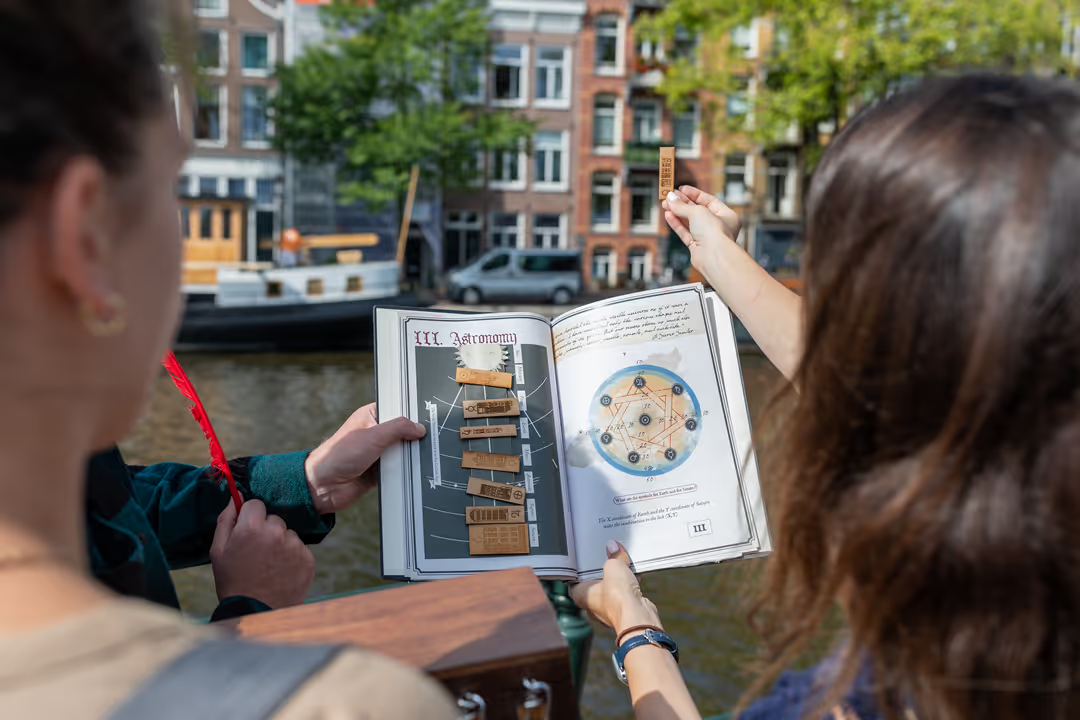
In the Rijksmuseum, we made players interns instead of adventurers. This narrative choice made it natural that they handled objects with care. In the Royal Palace, we used the architectural mosaics already on the floor as if they were part of the game board. The building itself became the puzzle.
Once we stopped fighting the restrictions, they started generating ideas.
Why Simpler Puzzles Often Work Better
.jpg)
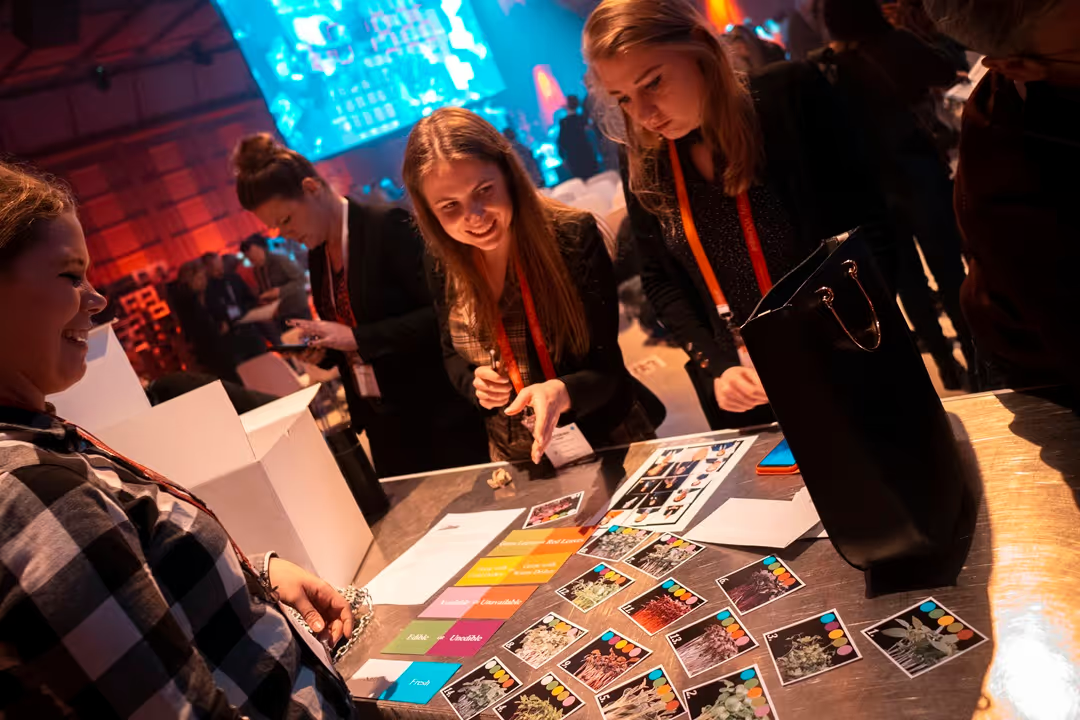
Across hundreds of tests, we have seen the same pattern repeat. Players respond more strongly to clear puzzles than to complex ones. They enjoy tasks that feel discoverable instead of tasks that feel instructional. They want to feel clever, not taught.
Simple puzzles tend to encourage collaboration and momentum. They break less often. They scale more easily for different kinds of groups. They let players build confidence instead of losing it.
A puzzle shouldn’t be the star of the show. The players should.
Common Pitfalls in Escape Room Design (And Why Constraints Prevent Them)
Here are the missteps we see most often, many of which constraints naturally steer us away from:
- Overbuilding puzzles that overshadow the story
- Filling the room with more information than players can process
- Assuming difficulty equals quality
- Skipping early testing
- Polishing an idea before checking if it actually works
- Using technology where a tactile mechanic would be more intuitive
- Forgetting that players haven’t lived inside your design for months
- Designing puzzles that require explanation instead of discovery
The tighter the constraints, the easier it becomes to avoid these traps.
Why Prototyping Early Matters

There’s a moment every designer knows too well: the internal monologue that says, “I’m sure players will understand this.”
They rarely do.
That’s not because the puzzle is bad, it’s because our proximity to the idea makes it impossible to see clearly.
Prototypes let you see how a mechanic holds up under real conditions. And rough prototypes reveal more honesty than polished ones. Players solve cardboard differently than they solve steel, and they reveal confusion faster when you have not hidden it under décor.
Constraints usually force this step earlier than we would choose, and we are grateful for that. They have saved us from repeating the €10,000 mistake.
Conclusion: Finding the Universe Inside the Box
Whether you are making a museum experience, an escape room, or a small puzzle for your living room, the most important question is not how to remove constraints. It is how to let constraints guide you.
Boundaries do not limit creativity. They point it in a direction. They help clear away noise so the essential shape of the experience can show itself. They make space for puzzles that players can understand, share, and feel proud of solving.
The magic of escape rooms doesn’t come from unlimited options. It comes from the world you build inside the limits you have.
Sometimes that’s an elaborate altarpiece with planets waiting to be aligned.
Sometimes it’s a folded piece of paper scribbled in ten minutes.
Sometimes it’s a €10,000 reminder still bolted to a wall.
But in all cases, the constraints are part of the story.
Table of Contents