.svg)
Book Now

Quick Summary
Before diving into the full story, here’s a clear snapshot of the key ideas...
- Optimal frustration is the core principle of good escape room puzzle design. Calibrate challenge so players feel the breakthrough, not the defeat.
- Every player type deserves a hero moment. Layering puzzle styles means analytical, spatial, visual, and collaborative thinkers each get their turn to shine.
- Narrative integration beats scale. A tight, coherent sixty-minute experience consistently outperforms a sprawling multi-room spectacle.
- The Candy Box is our system for parking brilliant ideas that don't fit the current project, rather than killing them. "We don't say no, we say not yet."
- Prototype before you polish. Cardboard and glue before CAD and paint. Test when it's still ugly enough that changing it doesn't hurt.
- Perfectionism has a cost, but when the design brief is making every player feel like a hero, the bar is always worth raising.
People step into an escape room expecting adventure, but underneath that excitement lives a quieter, more private fear: being the one who slows everyone down. The one who doesn't get it.
That fear is the real design challenge. Not the lock. Not the cipher. Not the theatrical set dressing.
At Sherlocked, our co-founder and creative director Victor van Doorn and co-director and lead experience designer Francine Boon have spent years building immersive escape rooms at the intersection of theatre, psychology, and puzzle design. If you want to understand what drives every decision we make, our mission and vision is a good place to start.
What follows are the principles that actually guide how we work, shared because we believe they're useful to anyone designing experiences where human emotion is the real deliverable.
The Core Principle of Escape Room Puzzle Design: Optimal Frustration
The most common mistake in escape room puzzle design is optimising for difficulty. Clever puzzles, complicated ciphers, multi-step logic chains. These may feel satisfying to design, but they're not what make players feel good.
Designing for emotion means prioritizing the moment of breakthrough over the complexity of the task.
That moment only works if the friction leading up to it was calibrated correctly. Too easy, and the solve feels hollow. Too hard, and the player disconnects emotionally long before they get there.
Francine describes this balance directly:
"We want you to be just frustrated enough that you feel the big win. And we want you not frustrated so much that you walk away from a puzzle."
This is what we call optimal frustration, a concept borrowed from educational psychology and poured into immersive game design. The goal is to keep players in productive struggle, where they feel genuinely challenged but never defeated.
The moment someone mentally checks out of a puzzle, the experience is over for them. What happens next in the room doesn't matter.
In practice, this means testing relentlessly (more on that below) and being willing to make a puzzle easier even when every instinct as a designer tells you to hold your ground.
Every Player Deserves a Hero Moment
Walk into most escape rooms with a group of six people, and within five minutes a natural hierarchy forms. The confident, pattern-recognising thinkers take the lead. The rest drift.
This is a design failure.
Groups contain multitudes: analytical thinkers who love logical sequences, spatial thinkers who need to physically move objects until something clicks, visual thinkers who spot what everyone else walks past, and collaborative thinkers who quietly synthesize everything the others find.
If your puzzle design only rewards one mode of thinking, you've written off a significant part of every group that walks through your door. This challenge becomes especially visible when you're designing immersive experiences for teen audiences, where the social stakes of looking lost in front of your peers are even higher.
"We don't design for you to feel dumb," Francine says. "That is not our goal."
The answer is deliberate variation. Layer challenges that require genuinely different cognitive approaches: a tactile puzzle for someone who thinks with their hands, a visual anomaly for someone with a sharp eye, a pattern-matching sequence for the person who's been waiting for exactly that moment.
The design goal is specific. Every player should have at least one moment where they're the one who cracked it. Not supported by someone else. Not following a lead. Actually the hero.
"So what we try to do is to always have a variation that can make sure that everybody at some point can feel like the hero of the game," Francine explains.
When a player who's been quietly orbiting the action suddenly spots the connection everyone else missed, the whole dynamic of the group shifts. That is the moment worth designing for.
Why "More Rooms" is Usually the Wrong Answer
As the escape room industry has matured, a visible arms race toward scale has emerged. Bigger budgets, more rooms, more elaborate theatrical production. The implicit message: more is better.
Victor disagrees.
"Something that I've seen lately, now that escape rooms have evolved into really spectacular experiences, is the 'more is better' fallacy," he explains. "In this trap, creators string together massive smorgasbords of rooms just to overwhelm the senses."
The problem is that sensory overwhelm and genuine wonder are not the same thing. One is accumulation. The other is curation. They produce very different emotional experiences.
A two-hour experience with seven rooms and forty puzzles can leave players exhausted rather than exhilarated. A tight sixty-minute experience with a coherent narrative arc and fifteen beautifully calibrated puzzles can leave them stunned. Part of what makes that possible is designing with constraints rather than despite them.
"I'd rather have a tight, compact, beautifully integrated experience that's an hour long than a two-hour long smorgasbord," Victor says.
Some of the best games we have ever played are incredibly intimate, like The Murder of Max Sinclair by Case Closed in Edinburgh or the beautifully designed Illusion right here in The Netherlands. They prove that you do not need fifty rooms to create lasting wonder.
The design principle at work is narrative integration. Every element in the room should exist because the story requires it, not because it was technically impressive to build. Scope creep in escape room design almost always comes from falling in love with our own ideas rather than asking whether those ideas actually serve the person in the room.
The Candy Box: A System for Ideas That aren't Ready Yet
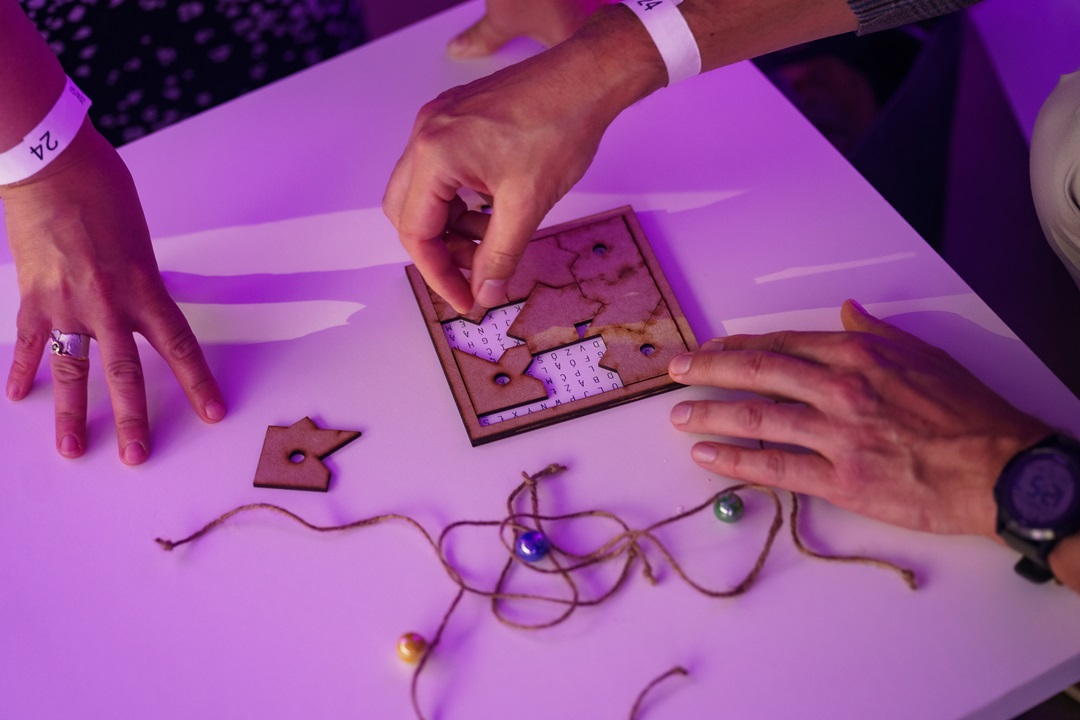
Every design process produces brilliant ideas that don't fit the current project. The standard response is to kill them and lose them. We don't do that.
Instead, we maintain what we call the Candy Box: a living collection of mechanics, puzzles, narrative conceits, and design ideas that were cut from active projects but are far too good to discard. The Candy Box is not a graveyard, it is a holding pattern:
"We park it in the Candy Box, knowing that at some point it might be the right fit," Victor explains. "So, we don't say no, we say not yet."
This has real practical benefits beyond emotional consolation. It allows us to respect the necessity of designing with constraints without feeling like we are losing our best work. It creates a cross-pollination effect between rooms built years apart and removes the sting of cutting a good idea. The idea isn't gone; it is simply waiting.
If you design experiences of any kind, the principle translates directly. Maintain a home for ideas that aren't ready rather than abandoning them. The moment of serendipity, when a shelved idea fits perfectly into a new brief, is genuinely one of the most joyful feelings in creative work.
Prototype Early, Prototype Ugly
The most important sentence in our design process: an idea that has not been tested in front of real people is a hypothesis, not a design.
We build cardboard prototypes. Ugly ones. Embarrassingly rough ones. We put them in front of test groups before they look like anything close to finished.
"As soon as an idea is born, we need to make a prototype out of cardboard and glue," Francine explains. "Because you have to put it in front of people while you still feel very embarrassed about it."
The logic is simple and slightly painful: the earlier you test, the less it costs to change. If you wait until something is polished before showing it to real players, you have too much invested to respond honestly to what you learn. The beautiful puzzle mechanic you have been perfecting for three weeks is the one you will find yourself defending when a test group dismantles it in forty-five seconds flat.
Cardboard prototypes short-circuit that attachment. They signal to everyone, including yourself, that this is not finished and feedback is the point.
"We test it all the time... and we can only check all our assumptions if we put it in front of people," Francine adds.
We learned this the hard way when we built The Vault. We spent roughly €10,000 on an elaborate, custom-engineered puzzle that we were incredibly proud of. But because we tested it too late, we realised only after installation that it created total confusion and killed the game's momentum.
This holds for digital experience design, brand activations, and product design just as much as it does for escape rooms. The medium changes. The principle doesn't.
Perfectionism as a Way of Working (and What It Actually Costs)
Everything above sits within a broader creative philosophy that, honestly, creates real tension with running a sustainable business.
We are perfectionists. We reinvest margin back into the rooms. We hire acting coaches. We iterate on experiences that have been open for years and generating revenue, because they're not yet exactly what we imagined them to be. A lot of that obsession lives in the details of blurring the line between fiction and reality, where the smallest inconsistency can break the spell entirely.
There is a piece of wisdom from fellow creator Chris Ladner that we have leaned on more than once when ambition outpaces resources: "If you do not have the budget left to make things pretty, you just do not light it."
But the deeper point is this. Every decision in the process, every puzzle we calibrate, every prototype we embarrass ourselves with, every brilliant idea we park rather than kill, is an act of empathy.
The player isn't an abstraction. They're a specific person with a private fear of being the slow one in the group, who walked in hoping for an adventure and deserves to walk out feeling like a hero. And as we've written about elsewhere, adults need play far more than we give them credit for. An escape room is part of the few places where that need gets taken seriously.
When that is the design brief, the bar is always higher than the budget allows. That tension is probably what good work feels like.
Let's keep making it.
Table of Contents