.svg)
Book Now

Quick Summary
Before diving into the full story, here’s a clear snapshot of the key ideas...
- Great escape room design starts with emotion, because players rarely remember the exact puzzle, but they do remember how the room made them feel.
- The feeling we aim for is wonder with confidence, as Francine says she wants players to leave with “a sense of awe and wonder and growth” and “a confidence boost from playing.”
- Players feel seen when they matter inside the story, which is why roles, character interactions, and agency are more powerful than anonymous lock-solving.
- Complex feelings belong in escape rooms, and Sherlocked deliberately designs for empathy, transformation, and emotional payoff, rather than stress or fear alone.
- Multisensory design protects immersion, because if something looks like marble, in Francine’s words, “it needs to be cold to the touch.”
- Optimal frustration is challenge with clarity, where puzzles feel fair enough to invite grit, but not so vague that they become irritating.
- The core memory we want to leave behind is story-shaped, the kind that makes players say “we just saved Mary” instead of only remembering a mechanism.
There is a moment that happens in almost every memorable room, and it has very little to do with a lock clicking open. It is the moment a player stops performing as a player and starts behaving like a person inside a story. They lean in. They whisper. They hesitate before making a choice. They reach out and touch something, not to solve it faster, but to check whether it is real.
That moment is where our work begins.
At Sherlocked, that work has been shaped for years by Victor van Doorn, our co-founder and creative director, and Francine Boon, our co-director and lead experience designer.
Together, they bring an unusual combination of disciplines to the table: story, sociology, spatial design, audience psychology, and a deep respect for craft.
Victor often speaks about building “impossible moments,” while Francine returns again and again to the question of how an experience can connect head, heart, and hands.
That is why, when Francine says, “We create an environment in which they can feel like the hero in their own story,” it does not land as a slogan. It lands as a design philosophy tested across years of building rooms, museum games, and mystery experiences that blur fiction and reality.
The Psychology of Player Emotion in Escape Rooms
For a long time, the main emotional engine of escape rooms was urgency. Beat the clock. Feel the rush. Get out in time. That still works, and there is nothing inherently wrong with adrenaline, but by itself it is thin. It tends to fade quickly, and it rarely becomes a core memory.
What stays is something more textured. Francine puts it better:
“I want you to discover something about yourself… and to hopefully walk out with a sense of awe and wonder and growth compared to how you walked in.”
That is the emotional target. Not mere relief, but a kind of grounded triumph. Not confusion, and certainly not emotional emptiness. We want players to leave with the strange, glowing thought that they may be more capable than they had assumed.
Francine has seen this happen repeatedly, with players walking out saying, “whoa, I didn’t know that I was such a leader,” or realising they solved something they thought was beyond them, which is precisely why she says Sherlocked creates spaces where people can feel like the hero in their own story.
There is a practical design lesson inside that philosophy. If the intended emotional outcome is wonder and self-belief, then every choice in the room has to support that. The room cannot humiliate players. It cannot lean too hard on panic. It cannot reduce people to a frantic blur of guessing. Emotion, in this sense, is not decoration added after the fact. It is the brief.
How Escape Rooms Make Players Feel Seen

There is a phrase floating through experience design right now, “players want to feel seen.” It can sound abstract until you watch what happens when a room actually does it well.
Francine defines immersion as “blurring the line between reality and fiction,” but she adds something equally important,
“I can be part of a world and I have agency in that world.”
Agency is the missing ingredient in a lot of otherwise beautiful rooms. If the player is only present to decode things, they are useful. If the world acknowledges them, depends on them, and makes sense because they are there, they become significant.
A lovely example comes from the Rijksmuseum game. We were asked to develop an escape game that would help the museum engage visitors in a more active, story-driven way, rather than guide them past objects with labels.
As Francine has explained, the ambition was to turn the museum from a place that simply displays things into a place where visitors follow their own curiosity, uncover stories, and accidentally learn about art along the way.
That brief came with a deliciously tricky constraint: the Rijksmuseum is full of priceless objects, regular visitors, and players who, once immersed, naturally want to run, shout, and touch everything. So instead of simply posting more rules, the team built a role.
Francine explains that players arrived not as game participants but as interns for a museum employee named Bert. “You are employees of the Rijksmuseum now,” they were told, and the whole environment supported that fiction. Guards, guides, and staff interacted with them as though they truly belonged there.
The design principle that emerged from this is one of Francine’s most practical lines:
“Give people a role that makes sense and that gives them responsibility because then they will act responsibly.”
It solved a behaviour problem, yes, but more interestingly, it made players feel woven into the story. They were not observers. They were needed.
Players tend to feel seen when:
- They are given a role that makes sense inside the world.
- The world responds to that role through staff, characters, or story logic.
- A character feels vivid enough that players want to help, rather than simply extract clues.
Designing Escape Rooms for Empathy, Wonder, and Emotional Payoff
The easiest way to provoke emotion in an escape room is still fear. Victor says it plainly:
“We also think it’s an easy way to get an emotional response is to make something scary, to just take away a person’s safety.”
The fact that it works does not mean it is interesting.
Francine’s answer is more nuanced.
“We do not create scary experiences because then you have much more responsibility to get people out of the fear again. We create experiences that give you a sense of wonder.”
That choice matters. Fear narrows the emotional palette. Wonder opens it. It leaves room for empathy, melancholy, tenderness, serendipity, and transformation.
This is more than theory for Sherlocked. Francine created experiences long before she joined the company, including a quest for her mother to help her move through different phases of grief. She describes play as something that helps people “learn and grow as humans,” and that belief sits underneath the whole body of work.
In practice, that emotional ambition has already shown up in the rooms.
“We have players that cry at the end of The Alchemist,” Francine says.
She recalls David Spira leaving and saying, “I never cry in escape rooms,” and also wanting to bring his parents afterwards. She mentions couples wanting to get married in the room, and players leaving with the feeling that “This touched me. This did something to me.”
That is the kind of emotional payoff we care about. Not theatrical misery for its own sake, and not vague claims about “immersion,” but a precise emotional arc where story, character, and environment quietly conspire to make players care.
Multisensory Escape Room Design, Why Touch and Texture Matter

There is a funny thing about tactile design. When it works, players barely notice it. When it fails, they notice at once.
Francine has a simple phrase for this: “touch real.” She puts it beautifully:
“If you touch a fireplace and it looks like marble, it needs to feel like marble. It needs to be cold to the touch.”
That idea was tested in a very practical way while building The Alchemist.
At one point, a builder suggested using a wooden fireplace surround to save money. We said no. If the object was meant to feel like stone, then it had to feel like stone. Otherwise, the illusion would fray.
That is what Francine calls the “huh moment,” the instant when a player’s hand says one thing and their eyes say another. In her words, “Anything that takes you out of the experience is ruining the experience.” Which is why details like surface temperature, material weight, and texture are never just decorative garnish. They are part of the structure holding the story together.
In practice, “touch real” means:
- If something looks like marble, it should feel cold.
- If a prop belongs in the story, its weight and texture should make sense in the hand.
- If a detail creates a small “huh” moment, it risks breaking immersion.
- If an action feels natural in the world, like handling keys or making tea, it can become part of the emotional logic of the experience.
This principle extends beyond rooms into Home Mysteries too. Francine loves that the materials make sense there as well, napkins scribbled on in bars, house keys used in unexpected ways, even the simple act of making tea.
None of these are random gimmicks. They are tactile pieces of narrative logic. The more faithfully the physical world behaves like the story says it should, the more naturally intuition can carry the player forward.
Smell and temperature are still underused in the wider escape room world, but the direction feels clear. We are increasingly drawn to environments that do not simply look convincing, but feel convincing in the hand and in the body.
Optimal Frustration in Puzzle Design
One of Francine’s most useful phrases is this: “We design for optimal frustration.”
It sounds a little severe, but it contains a whole puzzle philosophy. A puzzle should feel fair when it first lands in front of you. Players should be able to think, “I don’t fully get it, but I think I can do it.”
If it is too easy, there is no real satisfaction. If it is too hard, they give up. Optimal frustration lives in that narrow middle ground, enough grit to make the click feel earned, enough clarity to keep trust intact.
In practice, a puzzle reaches that sweet spot when:
- It feels fair at first glance.
- The answer feels within reach.
- The challenge creates grit, not vagueness.
- The payoff feels earned when the pieces click.
A very concrete example came from The Alchemist. Francine describes an early version of the sun in the room’s centerpiece. Because the surrounding planets could be twisted, players logically assumed the sun could be twisted too.
They twisted it, hard, and broke it. “We went through them within a month,” she says. The result was not delight but broken materials, splinters, and confusion, so we rebuilt it in a stronger material to make the intended interaction clearer.
That story matters because it reveals something important. When a player misreads a puzzle, the first question is not “Why did they do that?” but “What did we teach them to expect?” As Francine puts it,
“There are a hundred million ways in which you can break or interpret something,” which is why testing is not optional. It is fundamental.
The same principle shapes the emotional flow of a room. As Francine says,
“We design a flow of the whole experience for this emotional payoff.”
The first quest is often a little easier, so players feel capable early on. Only then do the harder challenges arrive, along with the bigger emotional payoffs. A good room does not simply escalate difficulty. It composes trust.
Escape Room Storytelling and Puzzle Integration
One of the quiet reasons some rooms feel magical and others feel stitched together is whether the puzzles belong to the story or merely occupy the same space.
Francine is very clear here.
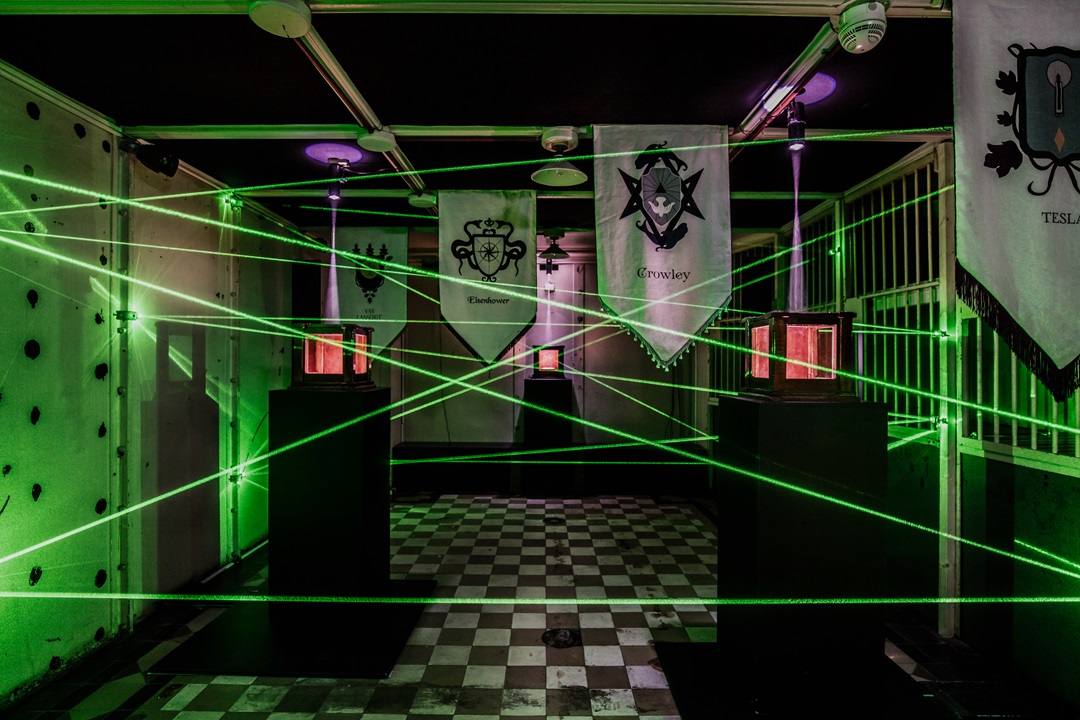
“The story and the puzzles and the building are integrated with each other.”
In her view, the building gives the first clues about what kind of experience can logically live there, and the story must then “propel the puzzles forward,” just as the puzzles must propel the story forward.
In practice, this is why Sherlocked makes so much use of site and alibi. In the Rijksmuseum, players were not simply directed through galleries. They were told to look at the gaze of a statue, find a painting and look at a specific element, turning the collection itself into both breadcrumb trail and narrative instrument.
Francine notes that this created a quick feedback loop that players loved, because the act of paying attention to art became the act of progressing through the game.
The same design logic appears in The Vault, where, as Francine explains, the puzzles exist because four families could not agree whether to share or destroy the Source. Their disagreement becomes the alibi for why descendants must prove themselves through a sequence of trials. It is fantasy, yes, but it is fantasy with internal logic.
That internal logic is what keeps story from becoming wallpaper. If a puzzle could be swapped into any room without changing its meaning, it may be clever, but it is not yet deeply integrated.
What Players Actually Remember After an Escape Room
If you ask Francine what success sounds like, she does not point to completion rates or even puzzle applause. She points to the way people talk afterwards.
“They say, we just saved Mary,” she explains, and when players speak like that, “then I feel like we succeeded because then we blurred the line between reality and fiction.”
That line says almost everything. The most durable memory is not “we solved a cipher.” It is “we did something that felt real.” Or at least real enough to keep glowing after the room is over.
Francine says she wants players to feel like there’s more mystery in the world than they previously thought there was. That may be the clearest description of the core memory Sherlocked is trying to implant. Beyond excitement, beyond competence, an aftertaste of wonder.
And perhaps that is why the room itself is never the full experience. The room ends, but the feeling lingers. A player remembers the coldness of the stone, the weight of a choice, the kindness or strangeness of a character, the sense that they were briefly the leading role in their own movie. The memory worth designing for is the one that leaves you feeling as though you did more than solve puzzles. You went on a full adventure.
In the end, puzzles matter deeply to us. We love their structure, their messiness, their strange little alchemy. But the better question for 2026 is not whether a room is difficult enough. It is whether it is alive enough to make someone feel something worth carrying home.
That is the kind of work we want to keep making. Rooms with tactile truth. Rooms with emotional clarity. Rooms that leave you a little more open, a little more curious, and just slightly suspicious that the world may still be hiding things in plain sight. Let’s keep building for that.
Table of Contents