.svg)
Book Now

Quick Summary
Before diving into the full story, here’s a clear snapshot of the key ideas...
- Escape rooms are contained, puzzle-driven experiences, usually set indoors where players solve challenges step by step to unlock a story.
- City Games transform the city into the playing field, blending narrative, exploration, and light puzzle-solving outdoors.
- Escape rooms focus on tight control and immersion, with lighting, sound, and pacing carefully designed.
- City Games embrace unpredictability and serendipity, because the real world becomes part of the experience.
- City Games are active and accessible, ideal for visitors and locals who want to rediscover a city in a fresh way.
- Both formats tell stories, but one unfolds within four walls while the other breathes through streets and canals.
At first glance, the difference between escape rooms and city games seems simple. One happens inside a room, the other unfolds across a city. But the real distinction runs deeper than location.
Both invite you into a story and ask you to notice details, trust your intuition, and work together. Yet the experience feels very different. One is a carefully crafted puzzle box. The other is a living city, full of movement, noise, and unexpected serendipity.
We learned that difference the moment we stepped outside.
The Room That Listens To You

There is a moment in every escape room when the door closes and the world narrows. The lighting shifts. The sound settles. Your senses sharpen. The room begins to whisper its logic.
In a traditional escape room, the experience is tactile and contained. Every object has been placed with intention. Every puzzle builds on the last. You move through a carefully constructed arc, solving challenges progressively until the story reveals itself.
At Sherlocked, our rooms are built like clockwork. We manage the light, the acoustics, the rhythm of discovery. If something feels off, we can trace it. If a puzzle confuses, we refine it. There is clarity in that control. The environment is more than a backdrop. It is an instrument.
What defines an escape room most clearly:
- A controlled indoor environment.
- Puzzles that build on one another.
- Strong sensory design through lighting, sound, and pacing.
- A tightly structured story arc.
- High immersion through deliberate detail and tactile interaction
Escape rooms are, at their heart, puzzle-driven experiences. The joy comes from cracking codes, finding hidden mechanisms, and feeling the alchemy of logic turning into insight. You are inside a designed world, and the world behaves according to rules we set.
That is their strength.
When The City Starts Talking Back

Then one day, we stepped outside.
Creating a city game meant more than expanding the map. It was stepping into beautiful chaos.
“One of the biggest challenges with creating something out in the real world is that we can’t control the environment,” Francine once said, half amused, half exhausted.
In an escape room, we control everything. In the city, anything can become a distraction or an accidental red herring. A street performer. A construction site. A curious tourist asking what you are looking for. Suddenly the world is improvising with you.
And yet, something magical happens when you let go.
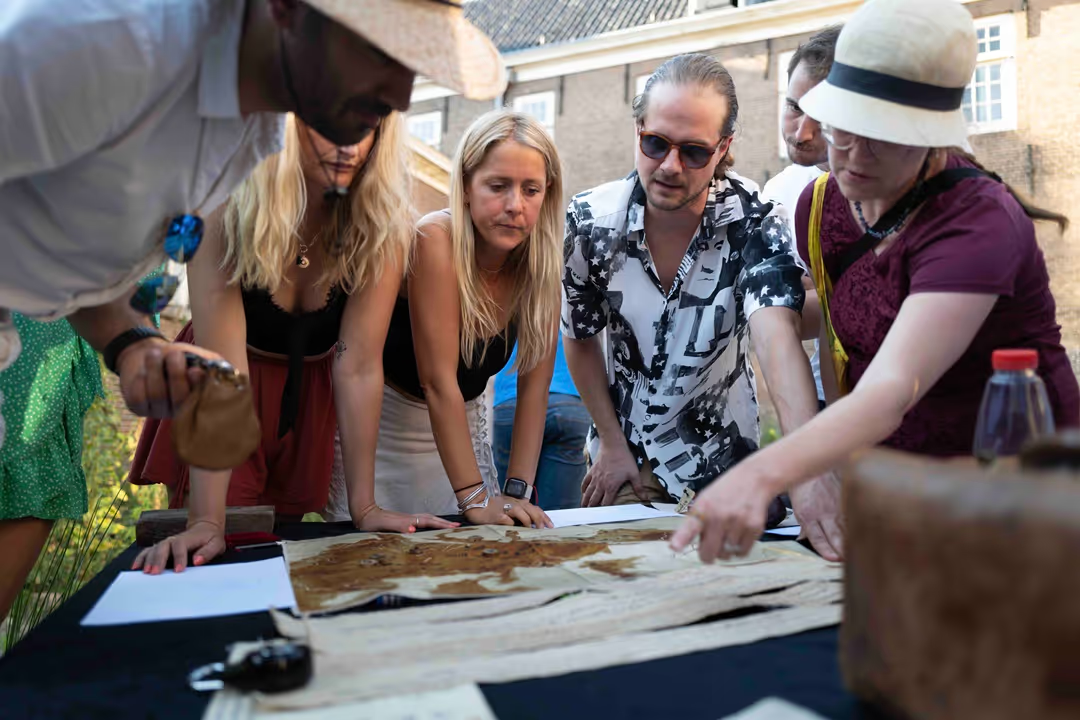
A city game transforms real streets, bridges, and hidden courtyards into a narrative playground. Instead of walking past landmarks, you interact with them. Instead of listening to a guide, you become the protagonist. The city is no longer scenery. It is the stage.
What makes a City Game feel different:
- The city itself becomes part of the story.
- Exploration matters as much as puzzle-solving.
- Real-world unpredictability shapes the experience.
- Puzzles are usually lighter and more intuitive.
- Players feel less like visitors and more like protagonists.
The puzzles tend to be lighter, woven into exploration rather than dominating it. The focus shifts from solving to discovering. From cracking codes to noticing patterns in architecture, history, and human behaviour.
It feels less like being locked in a box, and more like stepping into a novel.
If you’d like to dive deeper, read our blog on What is a City Game.
Puzzle Box vs Living City
The core difference between escape rooms and city games is not difficulty. It is ecology.
An escape room is a closed ecosystem. Every clue has a purpose. Every detail has been curated. If there is a book on a shelf, it matters. If there is a sound, it is intentional. This tight control allows for detailed puzzle chains and layered storytelling.
A city game is an open ecosystem. The wind exists. Traffic exists. Real life hums in the background. We cannot dim the sun or silence the tram. So we design differently. We design for flow, for intuition, for resilience.
The city becomes a collaborator, sometimes a trickster. You learn to navigate ambiguity. You learn to trust your instincts. The story unfolds through puzzles, but also through movement, conversation, and observation.
It is messier. It is also alive.
More Than A Walking Tour

There is a common misunderstanding that city games are simply walking tours with riddles attached. That misses the point.
On a walking tour, you observe. In a city game, you act.
You are not told what happened in a historic building. You might need to decipher something hidden in its facade. You are not passively absorbing information. You are chasing a thread through real streets, following clues that tie fiction and reality together.
Our own Amsterdam adventure, Atlantis Protocol, inspired by the intrigue of The Da Vinci Code and the deductive spirit of Sherlock Holmes, invites players into a layered mystery. It is not about ticking off landmarks. It is about feeling as if you have stumbled into a secret narrative humming beneath the surface of Amsterdam. We share more about the making of this experience in our blog on How We Built Atlantis Protocol.
For visitors, this often becomes the most memorable part of their trip. A few hours of exploration that feels purposeful and personal. For locals, it can be even more surprising. The familiar streets shift. A route you have cycled a hundred times reveals hidden textures you never noticed.
You rediscover your own city with fresh eyes.
Why We Needed Both
When we first built escape rooms, we fell in love with control. With precision. With the satisfaction of a perfectly timed reveal.
Then we built a city game and had to surrender that control. We had to design for rain, for noise, for unpredictability. We learned grit in a new way. We failed in new ways too. A clue that seemed obvious in testing became invisible in bright sunlight. A quiet square transformed into a festival ground overnight.
It was humbling.
But that humility taught us something essential. Storytelling does not require four walls. It requires intention and empathy. Whether indoors or outdoors, the goal is the same. To create a space, physical or urban, where people feel present, curious, and connected.
Escape rooms and city games are not competitors. They are different lenses on the same craft.
Choosing Your Adventure

If you crave concentrated immersion, detailed puzzles, and a controlled narrative arc, an escape room may be your sanctuary. It is intense, focused, and deeply tactile.
If you want movement, fresh air, and the feeling of stepping into a city-sized mystery, a City Game offers a different kind of thrill. It blends exploration with story, turning ordinary streets into something charged with possibility.
Both take just a few hours. Both invite you to collaborate, to notice, to think. Both can become the story you tell at dinner long after the day ends.
The difference lies not in which is better, but in how you want to feel.
Contained, or expansive.
Focused, or wandering.
Inside a room that listens to you, or inside a city that talks back.
Table of Contents